Writing/Language Arts ESOL Strategies
- Grace Hajj
- Nov 2, 2015
- 5 min read
Strategy 1: Verb Action ELD.K12.ELL.LA.1
English language learners communicate information, ideas and concepts necessary for academic success in the content area of Language Arts.
LAFS.1.W.2.5
With guidance and support from adults, focus on a topic, respond to questions and suggestions from peers, and add details to strengthen writing as needed.
As irregular verbs tend to pose a problem in learning to English language learners, this strategy focuses on using vocabulary in its right context. First, observe your students as they write and record which verbs they miss. Then, plan an active experiences for the students to perform with these new words. Have the students create an irregular verb journal where they then write about the experience they were a part of, and then use the verbs correctly in sentences. When it is all done, create a chart, bulletin board, or word wall that documents the irregular verbs that were studied in class, adding creative pictures and designs to the board.
Herrell, A. L., & Jordan, M. (2015). 50 Strategies for Teaching English Language
Learners (5th ed.). N.p.: Pearson.

Strategy 2: Using Acrostics
ELD.K12.ELL.LA.1
English language learners communicate information, ideas and concepts necessary for academic success in the content area of Language Arts.
CCSS.ELA-LITERACY.W.K.2 Use a combination of drawing, dictating, and writing to compose informative/explanatory texts in which they name what they are writing about and supply some information about the topic.
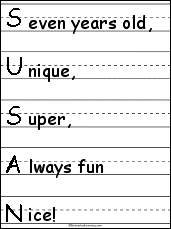
Have students write the letters of their name going down a page and capitalized, and then use the letters as a template to talk about themselves. Encourage students to write one word for each letter of their name that describes their personality or what they like to do for fun. Have them draw a correlating picture and share it with their classmates. This teaches ELLs the concept of poetry through acrostic writing, and it helps to provide a fun way to learn descriptive words about themselves that they are sure to use again in the future. http://www.colorincolorado.org/article/writing-poetry-english-language-learners
Strategy 3: Free Form
ELD.K12.ELL.LA.1
English language learners communicate information, ideas and concepts necessary for academic success in the content area of Language Arts.
CCSS.ELA-LITERACY.W.K.3 Use a combination of drawing, dictating, and writing to narrate a single event or several loosely linked events, tell about the events in the order in which they occurred, and provide a reaction to what happened.
This strategy helps ELLs get into the flow of writing easily by free writing anything they would like. Using free form, students don't have to worry about their grammar or spelling, they are just able to write whatever they would like to once they choose a topic. This helps them get into the system of smoothly writing without worrying about how it reads or looks like. When they are done, they can draw a picture that correlates to the event or topic they wrote about. The teacher can read over what they wrote just to see what came to their mind and where they are in the writing process.
http://www.colorincolorado.org/article/writing-poetry-english-language-learners

Strategy 4: KWL and Data Charts
ELD.K12.ELL.LA.1
English language learners communicate information, ideas and concepts necessary for academic success in the content area of Language Arts.
LAFS.K.W.2.5
With guidance and support from adults, respond to questions and suggestions from peers and add details to strengthen writing as needed.
This strategy enables students to write out what they know and what they want to learn. Introduce the chart to their students by telling them what the lesson for the day will be about, and then have them get in groups to write what they know and what they would like to learn from the lesson. Tell them to discuss with their peers what they wrote and to compare information and answers. Let students learn more by giving them books and resources to look over and learn more about the subject at hand. Tell students to write what they have learned from the lesson by filling out the L column of the chart. Make sure that students know and fully understand what they are writing about by providing small assessments.
Herrell, A. L., & Jordan, M. (2015). 50 Strategies for Teaching English Language
Learners (5th ed.). N.p.: Pearson.

Strategy 5: Using Graphic Organizers
ELD.K12.ELL.LA.1
English language learners communicate information, ideas and concepts necessary for academic success in the content area of Language Arts.
LAFS.2.W.3.8
Recall information from experiences or gather information from provided sources to answer a question.
This strategy is an excellent way for students to take the information that they gather either from a particular lesson or from given sources and materials and divide and organize it into systematized, well-laid out formation for them to refer to when answering questions and discussing with their peers. It is first helpful to tell the students what they are going to read and how they are going to organize the information they gather so that they can better understand. Model what it should look like and how they can shorten or elaborate on facts when necessary. Help them make connections between what they wrote in the organizer and what they read from the text, and make sure they get plenty of practice using graphic organizers.
Herrell, A. L., & Jordan, M. (2015). 50 Strategies for Teaching English Language
Learners (5th ed.). N.p.: Pearson.

Strategy 6: Scaffolding English Writing
ELD.K12.ELL.LA.1
English language learners communicate information, ideas and concepts necessary for academic success in the content area of Language Arts.
LAFS.2.W.2.5
With guidance and support from adults and peers, focus on a topic and strengthen writing as needed by revising and editing.
By modeling writing, teachers show English language learners how certain symbols can be used to represent English sounds. As the teacher writes a word on the board, she can say the word aloud. After showing students what the words look like and combining them into a sentence, the teacher can also provide the students with writing journals so that they can also write. After showing how the process works, the teacher then has the students draw and write, and then uses their picture to write a descriptive sentence for them. By looking at and hearing how the teacher wrote out the sentence for the picture, the students will better be able to understand how to write sentences on their own with repeated practice.
Herrell, A. L., & Jordan, M. (2015). 50 Strategies for Teaching English Language
Learners (5th ed.). N.p.: Pearson.

Strategy 7: Language Focus Lessons
ELD.K12.ELL.LA.1
English language learners communicate information, ideas and concepts necessary for academic success in the content area of Language Arts.
LAFS.1.L.1.1
Demonstrate command of the conventions of standard English grammar and usage when writing or speaking.
To better help English language learners grasp the language, watch your students and make note of what they tend to have errors on. Then, collect materials that will best suit their individual needs for language usage. Explain how to use the anguage by showing vocabulary and with models and talking about it to give context. Also allow students time to perform the new concept they are working on, and make sure the students spend a lot of time in practice.
Herrell, A. L., & Jordan, M. (2015). 50 Strategies for Teaching English Language
Learners (5th ed.). N.p.: Pearson.

Comments